
1. The Illusion of Endless Growth
Artificial intelligence has become the dominant force in global markets, driving valuations to historic levels. Tech giants are expanding aggressively, startups are raising capital at unprecedented speeds, and investors are pouring money into AI ventures without fully understanding the underlying technology.
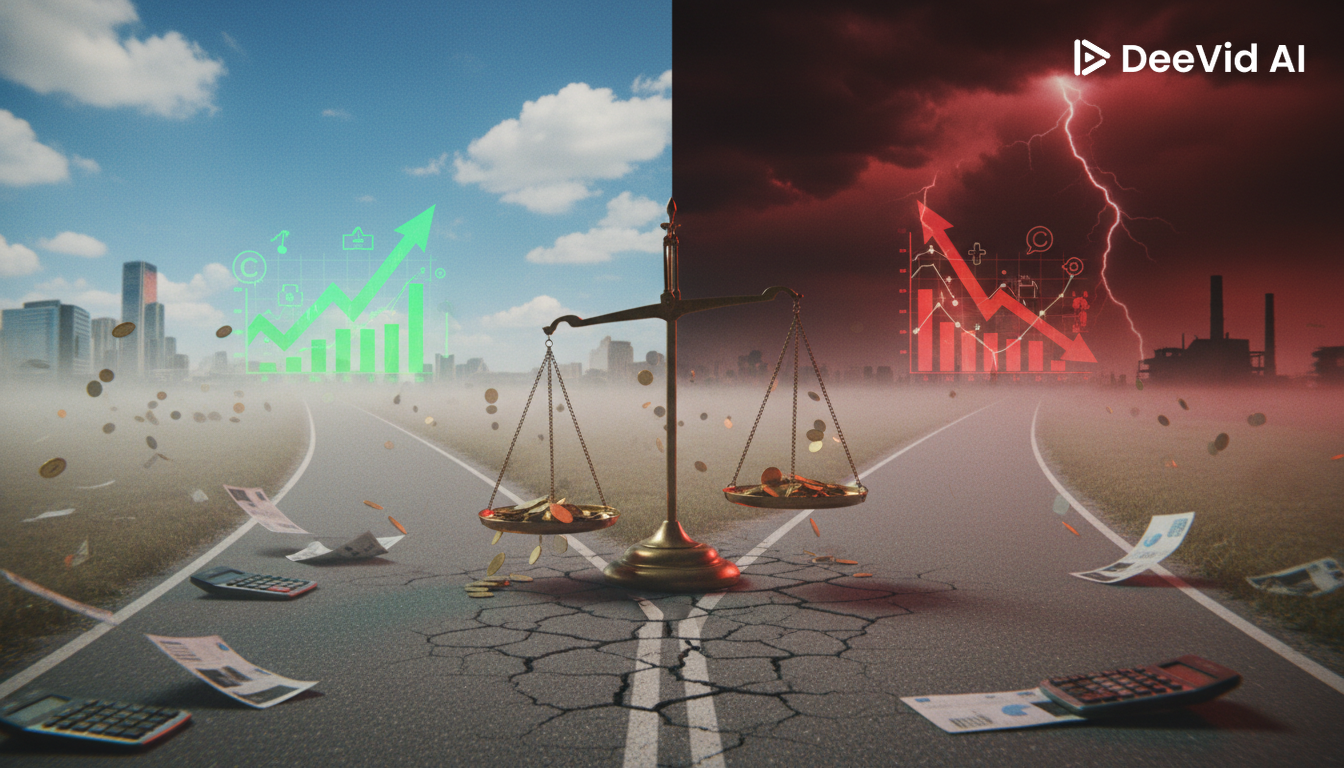
This optimism creates a distorted perception of stability. Growth seems unstoppable, but markets rarely behave linearly. Historically, industries that grow too fast without structural foundations face painful corrections.
2. Overvalued Startups and Inflated Market Caps
Many AI companies are valued based on future expectations rather than proven business models. Some firms generate minimal revenue but still secure billion-dollar valuations simply for adopting buzzwords like «AGI-ready» or «neural-adaptive compute.»
This mirrors the dot-com era, where excitement overshadowed fundamentals. If revenue does not eventually match valuations, the correction will be severe.
3. Centralization of AI Infrastructure
A small number of companies—mainly OpenAI, Google, Amazon, and Nvidia—control most AI compute capacity.
Businesses relying on these providers introduce systemic risk:
- Outages can halt global operations
- Pricing changes can disrupt profitability
- Policy shifts can restrict entire industries
This level of centralization makes the AI ecosystem more fragile than it appears.
4. Regulatory Shocks That Could Reshape the Industry
Governments worldwide are drafting aggressive AI regulations:
- Limitations on training datasets
- Mandatory transparency requirements
- Restrictions on automation
- Taxation of AI-generated output
Any regulation targeting foundation models could immediately devalue countless products dependent on them.
5. AI-Powered Cybercrime and Autonomous Threats
AI is now capable of generating sophisticated malware, deepfake fraud, voice spoofing, and automated phishing.
Financial institutions observe a surge in attacks created entirely by machine-generated code.
Companies unprepared for this new threat landscape may face unprecedented operational risks.
6. Workforce Displacement and Social Instability
Automation is replacing jobs in finance, media, customer service, logistics, and even software engineering.
The speed of displacement may exceed governments’ ability to adapt through re-education programs, creating long-term instability that could weaken entire markets.
7. Overreliance on Machine-Generated Decisions
Businesses use AI to optimize pricing, logistics, hiring, lending, medical diagnostics, and even legal analysis.
When companies outsource critical decision-making to algorithms they barely understand, they introduce:
- Liability risks
- Bias amplification
- Black-box failures
A single algorithmic error can generate billions in losses.
8. Unsustainable Computing Costs
Training and running large models demands massive energy consumption.
Companies often underestimate costs, leading to:
- Margin erosion
- Unscalable business models
- Dependency on subsidized compute
If energy prices increase or compute availability tightens, entire AI ecosystems could become financially unviable.
9. Global Competition and Geopolitical Tensions
The AI race between the U.S., Europe, and China accelerates rapidly. Export controls, chip bans, and political rivalries threaten to fragment the global AI market and introduce supply chain instability.



Más historias
Can the World Avoid a 2025 Recession? Economists Are Divided
The Future of Work and Automation: How It Will Reshape the Global Economy
The Global Debt Problem Is Worse Than You Think