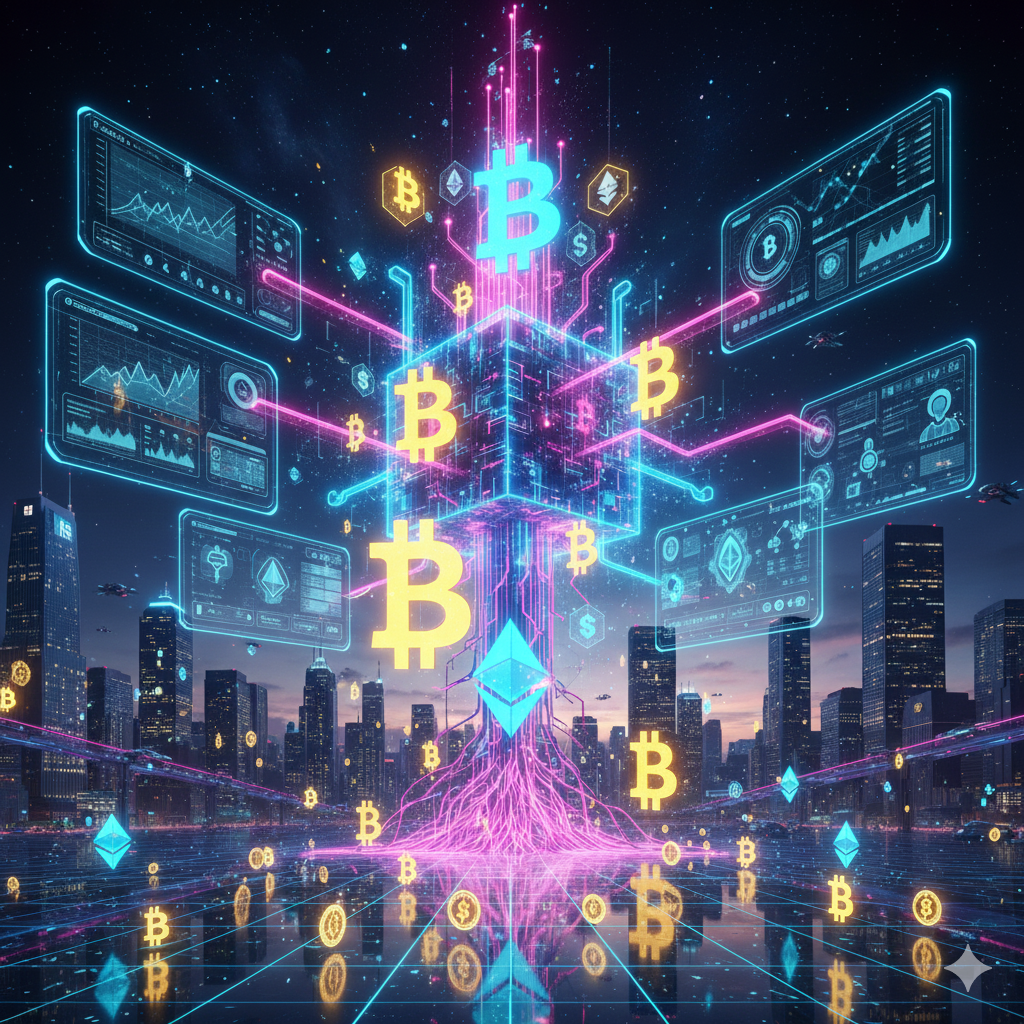
For years, blockchain technology was almost exclusively associated with Bitcoin and the broader world of cryptocurrencies. But as the digital economy evolves, it’s becoming increasingly clear that blockchain’s most transformative impact may occur far outside the realm of digital coins. Today, governments, corporations, and institutions are beginning to reimagine blockchain as a foundational infrastructure capable of reshaping how information, ownership, and value are stored and transferred.
The future of blockchain goes beyond speculation or trading—it’s moving into supply chains, identity verification, logistics, medicine, real estate, automation, and even governance. The technology is transitioning from a niche innovation to an essential tool for transparency, decentralization, and security in the digital era.
Below, we explore the forces pushing blockchain beyond cryptocurrency and how the next decade may redefine global systems.
1. Blockchain as a Trust Infrastructure for the Digital World
One of blockchain’s most valuable qualities—its ability to create trust in environments where trust does not naturally exist—makes it attractive for industries plagued by fraud, inconsistent recordkeeping, or centralized control.
In sectors like trade finance, copyright protection, pharmaceuticals, and logistics, data integrity is a critical priority. Traditional systems often rely on intermediaries to verify and authenticate records, which creates cost, delays, and vulnerabilities.
Blockchain provides:
- Immutable records that cannot be altered retroactively
- Transparent logs accessible to all authorized parties
- Decentralized verification without a single point of failure
This makes blockchain well-suited to act as the “trust layer” of the internet—an infrastructure that ensures data accuracy across global networks.
2. Supply Chain Transformation: Transparency from Origin to Consumer
One of the most promising applications of blockchain lies in supply chain management. Global supply chains are notoriously complex, often involving dozens of intermediaries across multiple countries. This complexity makes them vulnerable to fraud, counterfeiting, and inefficiencies.
Blockchain enables:
- Real-time tracking of goods from production to delivery
- Verification of authenticity for items like luxury goods, electronics, and medicine
- Instant auditing without relying on centralized databases
- Sustainability proof, showing whether a product was ethically sourced
Companies in industries ranging from agriculture to automotive manufacturing are adopting blockchain to enhance both efficiency and consumer trust.
In the future, it may become standard for every major retail product to include a blockchain-based traceability component—similar to nutritional labels on food today.
3. Decentralized Identity: Ending Passwords and Reducing Fraud
As digital identity theft grows globally, blockchain-based identity solutions are gaining momentum. Instead of dozens of passwords and database-stored personal information, blockchain enables self-sovereign identity—a system where individuals control their own credentials.
A blockchain identity can verify:
- Age
- Nationality
- Education or certifications
- Medical records
- Employment status
But critically, it can do so without exposing sensitive data. A bar, for instance, could confirm that a customer is over 18 or 21 without seeing their full ID.
Governments in countries like Estonia, Singapore, and the UAE are experimenting with blockchain-native identity solutions that could eventually replace physical documents. The future of digital identity may be secure, portable, and entirely blockchain-based.
4. Tokenization of Real-World Assets: A New Era of Ownership
Perhaps the most disruptive blockchain innovation beyond cryptocurrency is tokenization—the process of converting physical or financial assets into digital tokens that can be traded easily.
Tokenization is already being explored for:
- Real estate shares
- Fine art and collectibles
- Commodities
- Carbon credits
- Intellectual property rights
- Renewable energy
By breaking assets into smaller units, tokenization democratizes access to investments traditionally reserved for institutional players. A building worth $10 million can be represented by thousands of tokens, enabling fractional ownership.
This could redefine global financial markets by unlocking trillions of dollars in illiquid assets and bringing them into 24/7 decentralized markets.
5. Smart Contracts and Automation: The End of Manual Verification
Smart contracts—self-executing agreements that trigger automatically when certain conditions are met—are central to blockchain’s future. They remove the need for middlemen in processes such as:
- Insurance payouts
- Licensing agreements
- Real estate escrow
- Royalties distribution
- Global shipping workflows
Instead of relying on lawyers, brokers, banks, or manual approval, smart contracts enforce themselves, reducing delays and human error.
As AI becomes increasingly integrated into smart contracts, we’ll see blockchain-supported systems capable of making autonomous decisions based on real-time data. This convergence of AI + blockchain may produce new forms of automated commerce not possible before.
6. Blockchain in Healthcare: Secure, Unified Medical Data
The healthcare sector suffers from fragmented medical records, slow data sharing, and privacy vulnerabilities. Blockchain could solve many of these systemic issues by enabling:
- Unified patient records accessible across providers
- Tamper-proof medical history
- Secure sharing for research without exposing identities
- Authenticity verification of pharmaceuticals
With blockchain, patients can control their own health data and grant access selectively. This creates a more efficient and trustworthy healthcare ecosystem, reducing costs and improving outcomes.
7. Decentralized Governance and Voting Systems
Blockchain has the potential to reshape democratic participation by enabling secure, transparent, tamper-resistant digital voting. Governments and institutions are experimenting with systems that allow citizens to vote from smartphones or remote devices.
Blockchain voting can ensure:
- No double voting
- Transparent counting
- Immutable records
- Protection against tampering
Beyond political elections, blockchain governance is becoming popular in corporations and decentralized organizations (DAOs), where token holders can participate directly in decision-making. This represents a shift toward more inclusive, real-time governance structures.
8. Sustainability and Climate Solutions
Blockchain technologies are being explored as tools for improving environmental sustainability. Key applications include:
- Tracking carbon emissions across industries
- Verifying renewable energy production (e.g., solar, wind)
- Trading tokenized carbon credits
- Monitoring environmental impact with satellite data
The fusion of blockchain with climate tech could create more reliable systems for global sustainability reporting.



Más historias
Can the World Avoid a 2025 Recession? Economists Are Divided
The Future of Work and Automation: How It Will Reshape the Global Economy
The Global Debt Problem Is Worse Than You Think