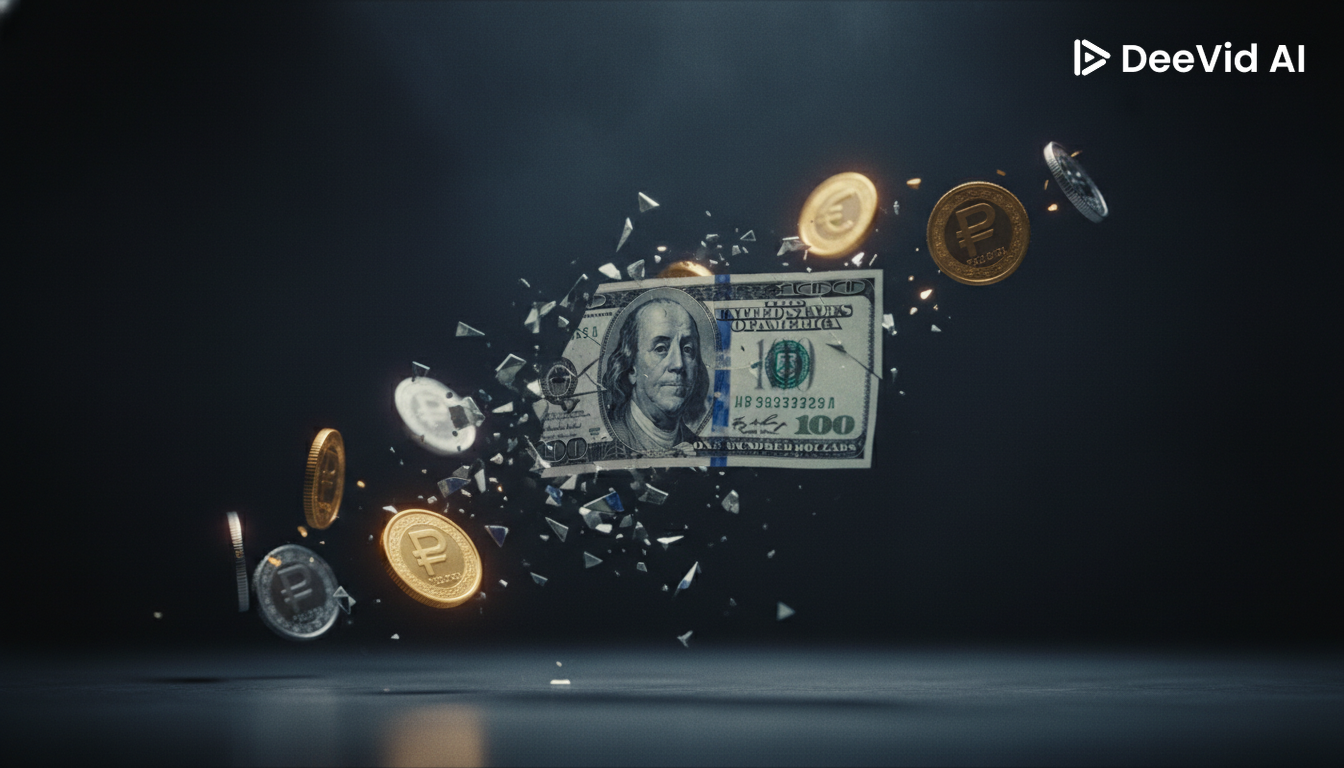
For nearly eight decades, the US dollar has served as the backbone of global finance. From international trade and commodity markets to government reserves and cross-border payment systems, the dollar has been the unquestioned anchor of the world economy.
But this dominance is no longer taken for granted. A growing number of countries are reducing their reliance on the dollar—an accelerating trend known as de-dollarization. What began as a slow, largely symbolic movement has evolved into a strategic global shift driven by geopolitics, economic pressures, and the desire for greater monetary independence.
This article explores why de-dollarization is rising, how nations are shifting their currency strategies, and what could happen to global markets if the dollar’s supremacy weakens.
1. Why De-Dollarization Is Accelerating
Geopolitical Tensions Are Reshaping Currency Alliances
In recent years, the United States has increasingly used the dollar-based financial system as a geopolitical tool—through sanctions, trade restrictions, and controls on international payments.
As a result, countries such as Russia, China, Iran, and several emerging markets have started seeking alternatives to avoid being financially vulnerable.
US Debt Levels Are Raising Global Concerns
The United States is facing record-breaking debt, with projections showing long-term fiscal challenges.
As US debt grows, foreign nations—especially those holding large quantities of US Treasury bonds—are questioning the stability of the dollar in the decades ahead.
The Rise of New Economic Blocs
Groups like BRICS (Brazil, Russia, India, China, South Africa, and new 2024 additions like Saudi Arabia and Iran) are openly pushing for a multipolar currency system.
Several BRICS countries are exploring new payment systems, gold-backed settlement mechanisms, and even a potential shared digital currency.
These combined forces have turned de-dollarization from a fringe idea into a mainstream global strategy.
2. How Countries Are Reducing Dollar Dependence
Trading in Local Currencies
China and Russia now settle most of their bilateral trade in yuan and rubles.
India has begun paying for energy imports from Russia in rupees.
Saudi Arabia has signaled interest in accepting currencies other than the dollar for oil sales—a monumental shift if it materializes.
Accumulating Gold Reserves at Record Speed
Central banks worldwide are buying gold at the fastest pace in over 50 years.
Gold is viewed as a neutral, stable asset outside the influence of any single government—making it an attractive hedge against dollar risk.
Developing Alternative Payment Systems
Russia’s MIR network, China’s CIPS (an alternative to SWIFT), and growing blockchain-based settlement platforms are reducing reliance on US-dominated financial rails.
Increasing Use of the Chinese Yuan
The yuan is steadily gaining traction in international trade.
It is now one of the top five global currencies for cross-border payments and a growing component of emerging-market reserves.
3. What Happens If the Dollar Loses Dominance?
Global Markets Would Become More Volatile
The dollar provides predictability and stability.
If its dominance declines, multiple competing currency systems could create volatility in commodities, exchange rates, and financial markets.
Energy Markets Could Fragment
Oil has been priced in dollars for nearly 50 years.
A true shift toward multi-currency energy pricing could reshape global energy flows and weaken US geopolitical influence.
Borrowing Costs for the US Could Rise
Dollar dominance allows the United States to borrow cheaply.
If global demand for dollars and US debt falls, borrowing costs could rise—impacting interest rates, government spending, and consumer markets.
Central Banks Would Need New Reserve Strategies
A multipolar reserve system would likely combine:
- dollars
- euros
- yuan
- gold
- digital currencies
This diversification would change how central banks manage risk and liquidity.
Financial Power Would Become More Distributed
If the dollar weakens significantly, the global financial system would become less centralized, reducing Washington’s ability to wield economic influence.
This could reshape alliances, trade policies, and conflict dynamics.
4. Could the Dollar Actually Lose Its Reserve Status?
The dollar is still overwhelmingly dominant:
- Over 58% of global foreign reserves
- More than 80% of global trade invoices
- Nearly all commodity markets priced in dollars
No alternative currently matches its liquidity, stability, and trust.
However, losing dominance doesn’t require being replaced entirely.
A gradual decline—where the dollar goes from 60% of global reserves to 40% over a decade—would still have massive economic implications.
De-dollarization is best understood not as a collapse, but as a slow erosion of influence.
5. The Most Likely Future Scenario
The world is moving toward a hybrid model—a multipolar currency system where:
- The dollar remains important
- The yuan and euro play larger roles
- Gold becomes a key reserve hedge
- Digital currencies support faster cross-border settlement
In this future, the dollar does not disappear but coexists with rising alternatives.
Conclusion: A New Financial Era Is Emerging
De-dollarization is no longer hypothetical—it is happening now, driven by geopolitics, technological innovation, and shifting global alliances.
While the dollar is unlikely to lose its top position in the near future, its share of global influence is slowly shrinking.
This transition marks the beginning of a more diversified, less US-centric financial world—one where global markets become more complex but also more balanced.
If the dollar eventually loses dominance, it would not just reshape currency markets—it would redefine the entire structure of global economics and power.



Más historias
Can the World Avoid a 2025 Recession? Economists Are Divided
The Future of Work and Automation: How It Will Reshape the Global Economy
The Global Debt Problem Is Worse Than You Think