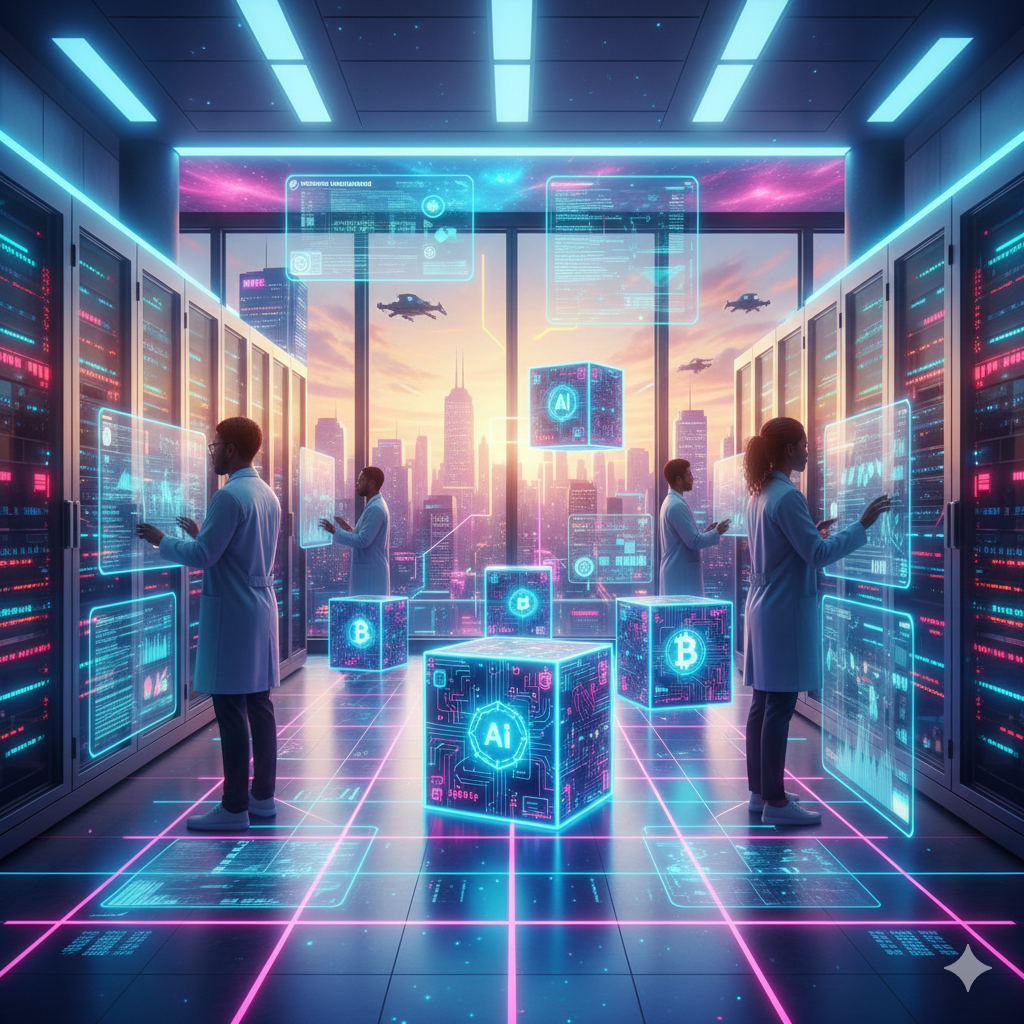
Artificial intelligence has rapidly become one of the most valuable technologies in the world, transforming industries such as finance, healthcare, cybersecurity, and logistics. But as AI models grow in size, power, and complexity, the infrastructure required to train and deploy these systems has become increasingly expensive and controlled by only a handful of tech giants.
This concentration of computational power raises serious questions:
Who controls the future of AI? Who decides which models get built? And who has access to the datasets that fuel innovation?
A new solution is emerging — blockchain-powered AI marketplaces. These decentralized ecosystems aim to democratize access to data, compute power, machine learning models, and AI services. Instead of relying on centralized companies, blockchain marketplaces allow anyone to contribute resources, earn rewards, and participate in a global AI economy.
This model could fundamentally reshape the future of machine learning, opening the door to a more transparent, accessible, and collaborative AI ecosystem.
What Are Blockchain-Powered AI Marketplaces?
Blockchain-powered AI marketplaces are decentralized platforms where users can buy, sell, train, or share AI models and datasets. These marketplaces combine blockchain technology with decentralized infrastructure to create trustless, transparent ecosystems.
In a decentralized AI marketplace, participants can provide:
- Computing power (GPUs, CPUs, or TPU clusters)
- High-quality datasets
- Pre-trained machine learning models
- AI services such as image recognition, text generation, or analytics
- Storage and bandwidth
- Tools for model evaluation and verification
All transactions between participants are governed by smart contracts, ensuring that payments, licensing, and usage agreements are transparent and automated.
This model breaks down the traditional barriers to AI innovation by distributing power away from centralized corporations.
Why AI Marketplaces Need Blockchain
Traditional AI development faces several major challenges that blockchain can solve.
1. Trust and Verification
AI marketplaces require users to trust that:
- Models are accurate
- Datasets are legitimate
- Compute providers deliver real results
- Usage is billed correctly
Blockchain provides trustless verification through transparent records, cryptographic proofs, and automated smart contracts.
2. Fair Monetization
Data owners, developers, and compute providers rarely get fair compensation in traditional AI pipelines. Blockchain ensures:
- Transparent payouts
- Automated royalties
- Usage-based payments
- Fractional model ownership
This enables a fairer economy for all contributors.
3. Avoiding Centralized Control
AI power is increasingly concentrated in a small number of companies. Decentralized marketplaces remove gatekeepers and enable anyone, anywhere to participate in AI innovation.
4. Decentralized Compute Power
Training large AI models requires enormous computational resources. Blockchain-powered networks like Akash, Render, Golem, and Bittensor allow users to provide GPU power and earn rewards, helping democratize access to compute.
5. Protecting Data Privacy
Zero-knowledge proofs and decentralized storage allow datasets to be used for training without revealing sensitive information — a major breakthrough for healthcare, finance, and government applications.
How AI Marketplaces Work
While each marketplace is unique, most follow a similar structure built on several decentralized components.
1. Compute Layer
GPU owners or operators provide compute resources. The network verifies:
- Performance
- Reliability
- Uptime
- Delivered training results
Providers earn tokens based on usage.
2. Data Layer
Dataset creators can upload data to decentralized storage networks like IPFS, Arweave, or Filecoin. Buyers can:
- Purchase access
- Use data to train models
- Pay micro-fees for usage
Blockchain ensures transparent licensing and ownership.
3. Model Layer
Machine learning models can be:
- Published
- Bought
- Licensed
- Fine-tuned
- Monetized through API calls
Each model has a traceable history recorded on-chain.
4. Marketplace Layer
Users interact with a decentralized platform where they can browse and purchase:
- Pre-trained models
- Compute time
- Datasets
- AI services
Smart contracts ensure secure, automated transactions.
5. Incentive Layer
Tokens reward contributors, similar to how DePIN networks operate.
Real-World Examples of Blockchain AI Marketplaces
Several major projects are pioneering decentralized AI ecosystems:
Bittensor (TAO)
A decentralized network of machine learning models that collaborate and compete. Models earn tokens based on their value to the network.
Ocean Protocol
A marketplace for data, allowing users to tokenize and monetize datasets.
SingularityNET
An open marketplace of AI services where developers publish algorithms that users can access through a decentralized API.
Fetch.ai
A network of autonomous AI agents that can complete complex tasks on behalf of users.
These projects represent the early stages of a much larger transformation.
The Benefits of Decentralized AI Marketplaces
1. Democratizing AI Access
Anyone with hardware, data, or technical skills can join the ecosystem and earn rewards.
2. Lower Costs
Decentralized compute is often cheaper than centralized cloud platforms.
3. Greater Innovation
Open marketplaces become hubs of collaboration, enabling small teams to compete with tech giants.
4. Transparency and Accountability
Everything — from training costs to model capabilities — is recorded on-chain.
5. Privacy-Preserving Training
ZK proofs enable AI training without exposing raw data.
6. Global Participation
Decentralized systems don’t rely on geographic restrictions or corporate approval.
Challenges to Overcome
Despite the promise, decentralized AI marketplaces face significant hurdles:
1. Technical Complexity
Onboarding non-technical users remains a challenge.
2. Model Verification
Ensuring that contributors provide accurate, high-quality models requires advanced evaluation mechanisms.
3. Network Latency
Distributed systems are slower than centralized cloud environments.
4. Regulatory Uncertainty
AI and blockchain both face evolving legal frameworks.
5. Token Volatility
Earnings depend on token prices, which may fluctuate.
Solving these issues is necessary for mainstream adoption.
The Future: A Fully Decentralized AI Ecosystem
Over the next decade, decentralized AI marketplaces could become the backbone of global machine learning infrastructure. We may see:
- AI agents that pay each other for data and compute
- Global, decentralized GPU networks training massive models
- Individuals monetizing personal data without giving it away
- Tokenized ownership of major AI models
- Open-source models competing directly with corporate AI
- Autonomous AI marketplaces scaling themselves without human oversight
This is a future where AI is not controlled by a small elite — but built collaboratively by the world.
Conclusion: Blockchain and AI Are Converging Into a New Digital Economy
Blockchain-powered AI marketplaces represent one of the most exciting frontiers in technology. By bringing decentralization to AI, these platforms unlock a future that is:
- More open
- More transparent
- More equitable
- More innovative
- More global
As AI continues to reshape every aspect of society, decentralized marketplaces ensure that power and opportunity are shared — not monopolized.
The convergence of blockchain and AI may be the most transformative shift of the next decade, creating a decentralized, intelligent digital economy where everyone can participate in building the future.


Más historias
Can the World Avoid a 2025 Recession? Economists Are Divided
The Future of Work and Automation: How It Will Reshape the Global Economy
The Global Debt Problem Is Worse Than You Think