
Global debt has reached historic levels, surpassing anything seen during previous financial crises or even major wartime economies. Governments, corporations, and households are borrowing at unprecedented rates, creating a fragile global system where even minor economic shocks could trigger major instability.
Despite the scale of the issue, public awareness remains limited. The debt crisis is expanding quietly behind headlines about inflation, geopolitical tensions, and slowing growth. Yet beneath the surface, structural imbalances are building—and they are far more serious than most people realize.
This article explores why global debt is spiraling, how economic systems have become dependent on it, and what risks lie ahead if corrective action is delayed.
1. The World Is Drowning in Debt
Debt Has Reached Historic Levels
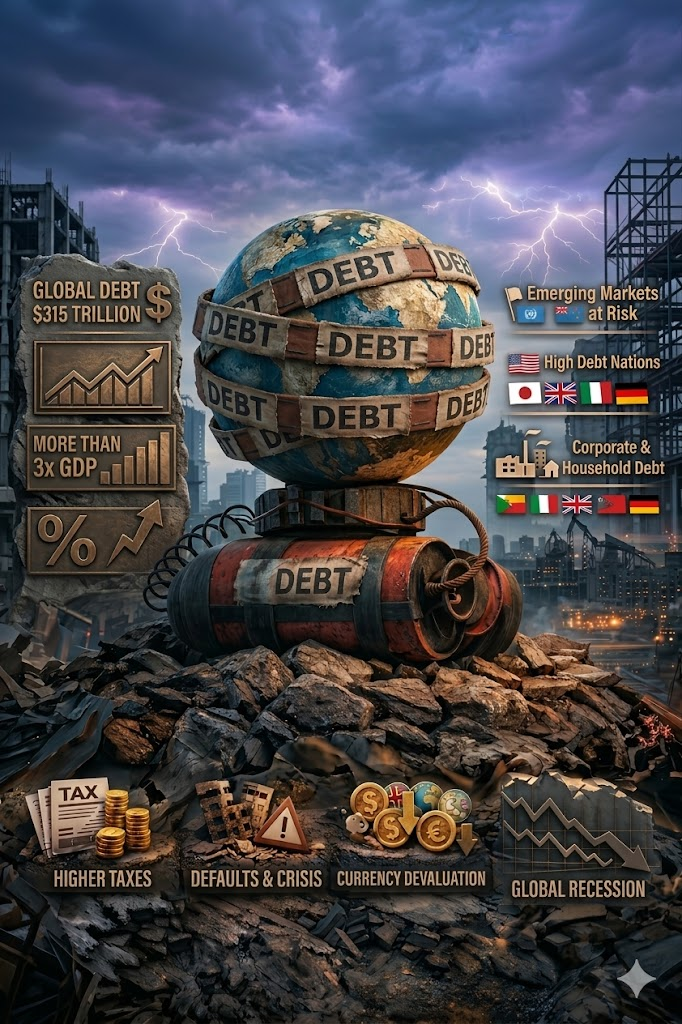
Global debt has now exceeded $315 trillion, significantly outpacing total global GDP. This means the world owes far more than it produces annually—a clear sign of structural imbalance.
What makes this particularly concerning is not just the size of the debt, but its growth trajectory. Over the past decade, borrowing has accelerated faster than economic expansion, pushing debt ratios to unsustainable levels.
Governments Are Borrowing Faster Than Ever
Public debt has surged as governments attempt to stabilize economies, fund social programs, and respond to crises. However, many countries are accumulating debt without generating the growth needed to support it.
As interest rates rise, debt servicing costs are consuming a larger share of national budgets, reducing fiscal flexibility and limiting future policy options.
Corporate Debt Is Another Silent Risk
Corporations took advantage of years of low interest rates to borrow heavily. Much of this debt was used not only for productive investment but also for financial engineering, such as share buybacks.
Now, with higher borrowing costs and tighter financial conditions, many companies face declining margins and increasing pressure to refinance expensive debt.
2. Why the Debt Crisis Is Getting Worse
Interest Rates Are Rising Worldwide
For years, low interest rates masked the risks of excessive borrowing. That era has ended.
Central banks have raised rates to combat inflation, dramatically increasing the cost of debt. What was once manageable is now becoming burdensome for governments, businesses, and households alike.
Economic Growth Is Slowing Down
Global growth is weakening due to demographic shifts, lower productivity gains, and geopolitical fragmentation. Slower growth reduces tax revenues and limits the ability of economies to “grow out” of their debt.
The result is a dangerous dynamic: debt continues to rise while the capacity to repay it declines.
Political Constraints Limit Action
Reducing debt requires difficult decisions—cutting spending, raising taxes, or implementing structural reforms. These measures are often politically unpopular.
As a result, many governments delay action and continue borrowing to maintain short-term stability, even at the cost of long-term sustainability.
Debt Dependency Is Now Structural
The system increasingly relies on debt:
- Governments fund essential services through borrowing
- Corporations depend on debt for expansion and liquidity
- Households rely on credit for housing, education, and consumption
This deep dependence makes the global economy highly sensitive to interest rate changes and financial shocks.
3. Which Countries Are Most at Risk?
Emerging Markets
Emerging economies are particularly vulnerable due to high levels of foreign-denominated debt. Currency depreciation can sharply increase repayment costs, creating immediate financial stress.
Countries such as Argentina, Turkey, and Pakistan are already experiencing severe pressure, with rising default risks.
Highly Indebted Developed Nations
Even advanced economies face growing challenges. The United States, Japan, Italy, and the United Kingdom carry large debt burdens that are becoming increasingly difficult to manage.
While these countries benefit from stronger financial systems and reserve currencies, their long-term fiscal trajectories remain concerning.
Commodity-Dependent Economies
Countries reliant on exports of oil, minerals, or agricultural goods face additional volatility. When global commodity prices fall, government revenues decline, making debt obligations harder to meet.
4. What Happens When Debt Becomes Unmanageable?
When debt levels exceed a country’s ability to manage them, several outcomes become likely:
- Higher taxes and reduced public services, slowing economic activity
- Debt restructuring or default, which can destabilize markets
- Currency devaluation, reducing real debt but increasing inflation
- Financial crises, with potential global spillover effects
In an interconnected world, a crisis in one major economy can quickly spread, amplifying systemic risk.
5. Why This Crisis Is Different
This debt cycle is more dangerous than previous ones for several reasons:
- It is global rather than regional
- Debt is high across all sectors simultaneously
- Interest rates are rising instead of falling
- Economic growth is slowing
- Political fragmentation delays necessary reforms
Unlike past crises, there is no clear “safe zone.” The risks are widespread and interconnected.
6. Is There a Way Out?
Addressing the global debt problem will require coordinated and often difficult actions:
Fiscal Reform
Governments must improve budget discipline, reduce deficits, and prioritize sustainable spending.
Debt Restructuring
In some cases, renegotiating debt terms will be unavoidable to prevent systemic collapse.
Growth-Oriented Policies
Investments in productivity, innovation, and infrastructure can help improve long-term economic capacity.
Rethinking Monetary Policy
Central banks may need to balance inflation control with financial stability more carefully, especially in highly leveraged economies.
Conclusion: A Ticking Time Bomb
The global debt problem is far worse than most people understand.
With rising interest rates, slowing economic growth, and widespread financial dependency, the world is edging closer to a tipping point.
If left unaddressed, this crisis could reshape global markets, strain government budgets, and weaken economic stability for years to come.
Debt has become the hidden fault line beneath the global financial system—and it is deepening.
Whether the world acts now or waits until crisis forces action will determine how severe the consequences become.


Más historias
Can the World Avoid a 2025 Recession? Economists Are Divided
The Future of Work and Automation: How It Will Reshape the Global Economy
The Rise of De-Dollarization: What Happens If the Dollar Loses Dominance?