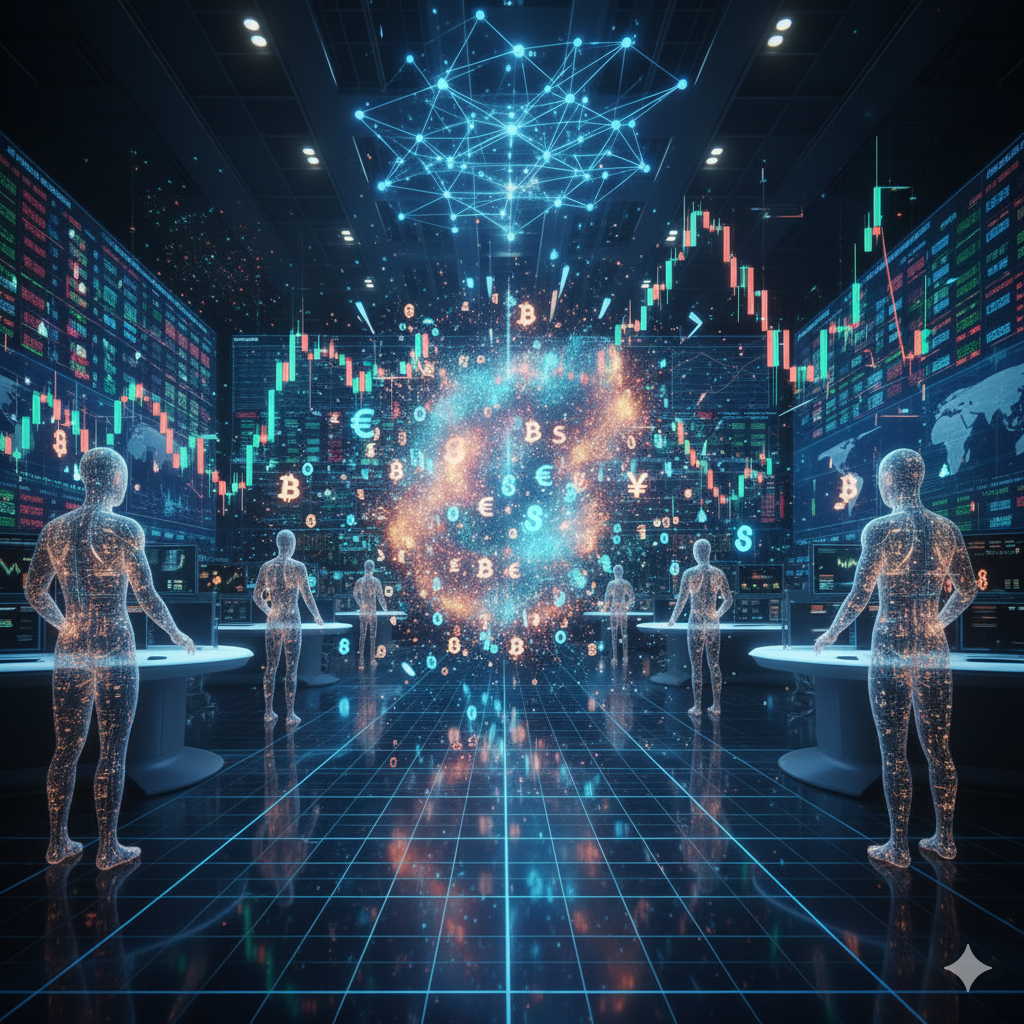
The financial markets have undergone massive changes over the past several decades, but few transformations have been as disruptive—or as promising—as the rise of artificial intelligence (AI) and machine learning (ML). What began as a niche quantitative tool used by hedge funds has now become one of the defining forces in modern trading. Today, AI-driven systems analyze billions of data points, execute trades in microseconds, predict market behavior, and help traders manage risk with unprecedented accuracy.
This article explores how AI and machine learning are reshaping trading—from algorithmic execution and sentiment analysis to portfolio optimization, fraud detection, and the democratization of sophisticated trading tools.
1. The Rise of AI-Powered Trading: A New Era for Financial Markets
Traditional trading relied heavily on human intuition, experience, and manual analysis. But as markets became faster, more complex, and more integrated globally, the limitations of human judgment became clear. AI and machine learning emerged as a solution that could handle the scale, speed, and data volume of modern finance.
Today, AI is integrated into almost every part of the trading lifecycle:
- Market data collection
- Price forecasting
- Risk assessment
- Trade execution
- Portfolio management
- Sentiment and news analysis
- Fraud detection
- Regulatory compliance
These systems can process historical and real-time data far beyond human capabilities, identify patterns that escape the eye, and adjust strategies as conditions change. The result is faster, more accurate, and more adaptive trading.
2. Machine Learning Models Are Redefining Market Prediction
At the core of AI-driven trading is machine learning—algorithms that learn from data and improve over time. Unlike traditional financial models that rely on fixed equations, machine learning models adapt dynamically.
Key ML models used in trading include:
a. Neural Networks
Neural networks mimic the structure of the human brain, learning complex patterns across massive datasets. They are particularly effective in forecasting non-linear relationships in markets.
b. Reinforcement Learning (RL)
In RL, algorithms learn by trial and error, making it ideal for developing automated trading strategies. RL agents test thousands of strategies in simulations, optimizing decisions based on rewards (profits) and penalties (losses).
c. Natural Language Processing (NLP)
NLP models analyze news, social media, corporate filings, and earnings transcripts to gauge sentiment and detect events that could move markets.
d. Time-Series Models
Models like LSTMs (Long Short-Term Memory networks) are designed to analyze sequential data such as price movements, volatility trends, and macroeconomic indicators.
Together, these models create powerful tools that can forecast short-term movements or identify long-term opportunities with greater precision than ever before.
3. Algorithmic and High-Frequency Trading: Faster Than Human Reflexes
One of the earliest and most visible transformations brought by AI is the rise of algorithmic trading and high-frequency trading (HFT). These systems execute trades based on predetermined rules, statistical relationships, or AI-driven predictions.
How AI changed HFT:
- Microsecond execution: Machines react faster than humans ever could.
- Real-time adaptation: Algorithms continuously adjust strategies based on live data.
- Smart order routing: Trades are automatically directed to the most favorable exchanges.
- Predictive liquidity analysis: AI estimates where liquidity will appear seconds in advance.
HFT now accounts for a significant portion of trading volume in major markets. While controversial due to concerns about volatility, it has increased liquidity and reduced bid-ask spreads for retail investors.
4. Sentiment Analysis: Reading the Market’s Emotions
Financial markets are influenced not just by numbers but by emotions. Fear, greed, optimism, and uncertainty drive behavior. AI is now capable of quantifying these human emotions at scale.
Using NLP, AI systems can analyze:
- Breaking news headlines
- Social media platforms (especially X/Twitter)
- Reddit and community forums
- Analyst reports
- Corporate announcements
- Economic and political updates
Advanced sentiment models assign scores to news or posts and correlate them with potential price movements. For example, if sudden negative sentiment sweeps across social media about a stock, an AI system may adjust positions in real time—long before human traders even notice the shift.
5. Risk Management and Fraud Detection Reinvented
AI is not only transforming how traders make money—it’s also reshaping how they protect it.
AI-powered risk management includes:
a. Real-time volatility forecasting
ML models detect anomalies or unusual behavior in markets, allowing traders to adjust exposure quickly.
b. Portfolio stress testing
AI simulates thousands of market scenarios to assess how portfolios would perform under different conditions—economic crashes, rate hikes, geopolitical tensions, etc.
c. Fraud and manipulation detection
AI systems identify:
- Insider trading patterns
- Spoofing and wash trading
- Abnormal order flows
- Identity theft or account breaches
Banks and trading platforms increasingly rely on these tools to maintain integrity, reduce risk, and comply with regulations.
6. Democratization of Trading: AI for Everyone
One of the most significant impacts of AI on trading is accessibility. Tools that were once exclusive to hedge funds and investment banks are now available to retail traders and small investors.
Examples of democratized AI tools:
- AI-driven trading bots
- Copy-trading platforms
- Auto-portfolio rebalancers
- Robo-advisors
- Sentiment and signal analysis tools
- Retail algorithmic trading software
Platforms like eToro, Robinhood, and TradingView now integrate AI-driven insights, while new startups offer ML-based signals at low costs. This shift allows even small investors to compete with institutional players—something unthinkable just 10 years ago.
7. Challenges and Risks of AI in Trading
Despite its benefits, AI-driven trading comes with serious challenges.
a. Overfitting and false predictions
ML models can misinterpret noise as meaningful patterns, leading to poor real-world performance.
b. Flash crashes
Automated systems can trigger rapid, large-scale sell-offs when reacting to misinterpreted data.
c. Black-box models
Many AI models are not easily interpretable, making it difficult to understand why certain decisions are made.
d. Regulatory uncertainty
Governments are still figuring out how to regulate algorithmic trading, market manipulation, and AI-driven strategies.
e. Data quality issues
Bad or biased data can lead to disastrous trading strategies.
8. The Future: What AI Will Bring to Trading Next
AI is still in its early stages in finance. The next decade will bring:
AI agents that negotiate and trade autonomously
Fully automated portfolios that adapt to your behavior
Quantum-enhanced trading algorithms
Predictive models capable of identifying market cycles
Integrated AI advisors offering real-time trading guidance
As computational power grows and datasets expand, trading will become increasingly automated, efficient, and predictive. Human traders won’t disappear, but they will increasingly rely on AI as their most powerful ally.

Más historias
Can the World Avoid a 2025 Recession? Economists Are Divided
The Future of Work and Automation: How It Will Reshape the Global Economy
The Global Debt Problem Is Worse Than You Think